
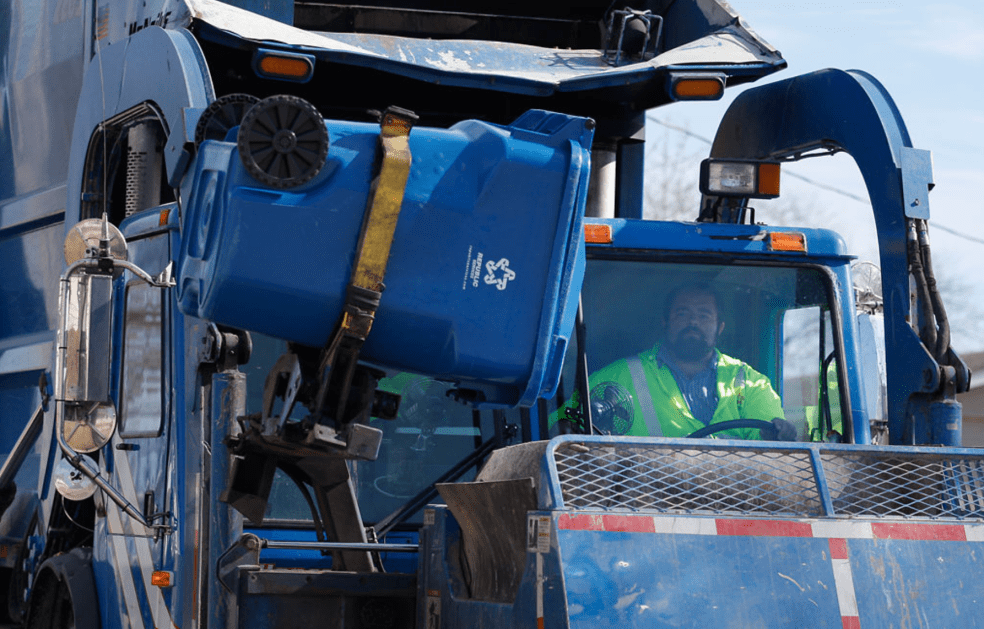
Earlier this month, representatives of the Columbia Public Works Department and the Office of Sustainability made a presentation to the Columbia City Council that addressed the challenges of trash and recycling collection and proposed a rollcart system that they say could reduce the amount of trash going to the landfill as well as workers’ compensation claims and employee turnover among trash collectors.
Public Works Director John Glascock at a Jan. 5 council work session described the current system, in which residents dispose of trash in black plastic bags and recyclables in blue bags, as antiquated.
The city provides the bags for free. In a few neighborhoods, residents put their recyclables in plastic bins.
“We need a new system,” Glascock said. “We need something better than what we have.”
Roll carts also would allow a “pay as you throw” system in monthly bills that would rise with the amount of trash discarded. City staff is proposing the city offer three sizes of roll carts with a monthly charge of $15 to $20, depending on the size of cart a resident wants.
The proposal calls for continuing to offer trash bags as a premium service that would cost more. The city would charge a base rate of $12.50 per month, plus $1.50 per bag.
Public Works Department spokesman Steven Sapp said all of those charges are good estimates but remain subject to approval by the council.
Officials at the Jan. 5 meeting emphasized the automated system’s potential for increasing the city’s recycling rate. According to the presentation, Columbia’s diversion rate — the percentage of refuse that does not go to the landfill — is 17 percent. That’s half the national average.
Roll carts also would be expected to bring down employee turnover in the Solid Waste Division, which is now 68 percent. The city’s overall turnover rate is 8 percent.
“Nobody wants to do that type of work anymore,” Sapp said of trash collection.
Sapp noted that the job is labor intensive work, requiring employees to pick up 900 or more trash bags per day, regardless of the weather, for $10.75 to $12.75 per hour. Twenty-six employees are needed to cover all residential pickup routes. The city is short employees now.
Glascock described the job as dangerous, noting there have been fatalities, serious injuries and numerous minor injuries. Research indicates that workers’ compensation claims drop when automated systems are adopted.
Sapp said trash collectors would be put to work at the city recycling facility if an automated system is adopted.
“Our intention is not to lay any current employee off,” Sapp said.
A timetable proposed at the meeting shows the city moving toward an automated system by October 2017, when it would order carts and required equipment. It would expand the city recycling facility in fiscal 2018 and could have a roll cart system fully operational by fiscal 2019.
“We would not need to replace trucks to be able to handle automated collection,” Sapp said. The department plans to mount Curotto-Can attachments, at a cost of $35,000 to $40,000 apiece, on the front of existing trash trucks.
Over the long term, the reduction in workers’ compensation claims and other savings would offset the cost of adapting the trucks and buying and distributing carts, Sapp said.
“There is a capital outlay first, and then it has a return on the investment that helps pay for that,” he said.
City staff plans to launch a community “trash talk” over the next several months. It plans meetings in each of the city’s six wards from the middle of February through early May, along with one or two Saturday forums for those who can’t attend the ward meetings.
Sapp said the intent is to have a conversation through which the city can learn more about residents’ concerns.
“We’re not trying to tell people what type of collection method they must choose,” Sapp said. “We are trying to offer options. We do need our customers to understand the difficulties we are having delivering the current service. We’re looking forward to a two-way conversation with our customers at the ward meetings and forums.”
Switching to roll carts was proposed and heavily discussed in 2012, but many residents talked. They complained about potential employee layoffs and about the inconvenience and ugliness of the carts.
Chuck Headley, a member of the Solid Waste Action Group, remains opposed to roll carts.
“We would really like to have a public hearing, and we would like to talk about our issues, make our presentations and ask a few questions,” he said.
Columbia resident Richard Shanker said the city is trying to sell the idea of roll carts.
“This time they are using the recycling aspect to get it pushed through,” he said. “The presentation gave us both good information and inaccurate information; I just thought that it is going (the) wrong way.”
This is published on Columbia Missourian, a Columbia local newspaper.

