Missouri Racial Disparity Project

This project is for a class named Computer-assisted Reporting. We worked on obtaining law enforcement data to build indicators for the Missouri racial disparities project covering 22 cities with black people comprising more than 10 percent of the population.

We worked on six types of datasets covering arrests, police force and revenue. We reviewed data available on the websites and sent letters of request to the Missouri Attorney General’s Office, Office of State Courts Administrator, Missouri State Highway Patrol, and each city government. We also used the 2010 census data from the U.S. Census Bureau.

Discoveries

  1. Arrest warrants rate      

Arrests per 10,000 people were highest in Ferguson, Jennings, St. Ann, Hazelwood and St. Louis. St. Louis, Ferguson and Jennings are also among the top 10 cities with the highest black population.

  1. Traffic-stop disparity

Nearly all or 19 of the 21 cities (with data) have a higher disparity index for black people than white people. Only Bellefontaine Neighbors and Moberly police departments reported disparity indices that are higher for white people than black people. Jennings Police Department did not submit a report to the Attorney General’s Office.

  1. Juvenile arrest disparity

All 22 cities have a higher disparity index for black juveniles than white juveniles. University City is on top with a disparity index of 36.03. Bellefontaine Neighbors, Moberly and Columbia follow with indices of 12.70, 6.34 and 5.44, respectively. Poplar Bluff is at the bottom with a disparity index of 1.23.

  1. Adult arrest disparity

Black adult arrest rates in all 22 cities are higher than those of white adults. Hazelwood, with a 6.91 disparity index, ranks first. The City of Columbia placed fourth with a disparity index of 5.50. Of the 22 cities, the black adult arrest rate in Jennings City is almost the same as that of white adults.

  1. Court revenue share      

The percentage of court revenue out of the total revenue is below 5 percent for many of the 22 cities. In St. Ann, the court revenue accounted for about 40 percent of its total revenue, which is way more than the percentage of other cities. St. Ann is followed by Bellefontaine Neighbors and Ferguson with 14.9 percent and 10.2 percent, respectively.

The data was used in a story of KBIA, NPR-affiliated station, called “How Columbia could be more segregated than Ferguson.”

War Crimes Court Faces Questions Over Bias, Efficiency

After wars in the former Yugoslavia and Rwanda killed nearly a million civilians, 120 nations came together to create what we know as the International Criminal Court. The goal: to prosecute those responsible for future genocides, crimes against humanity and other terrible war crimes.

But 13 years after it was created, the ICC has seen its share of controversy. Some African leaders are threatening to withdraw from the court for what they see as its unfair focus on prosecuting African cases. Others question the usefulness of a court that has convicted just two people in 13 years.

Joining the program are:

  • John Dugard, a professor of law at the University of Leiden in the Netherlands and a UN special rapporteur on human rights in the Palestinian territories.
  • Maxine Kamari Clarke, a professor of international and global studies at Carleton University in Ottawa.
  • Beth Van Schaack, a visiting professor in human rights at Stanford Law School and a former deputy to the U.S. ambassador-at-large for War Crimes Issues.
  • Abdullahi Boru Halakhe, an East Africa researcher at Amnesty International.

Listen to the radio program here.

A look inside North Korea

North Korea has long been a forbidden land for journalists, human rights advocates, and pretty much anyone who publicly disagrees with the regime’s philosophies and practices.

But there have been more and more cracks in the facade, and people are beginning to share their stories with the rest of the world.

Our guests this week:

Watch the video program here.

Ecuador Cartoonist Hit by Correa’s Crackdown

If there’s a face of Ecuador’s widening efforts to censor the press, it’s cartoonist Xavier Bonilla. Known by his pen name Bonil, his biting criticism of President Rafael Correa’s government has led to two high-profile run-ins with Ecuador’s new censorship office, the Superintendent of Information and Communication, or SuperCom.

Created by a 2013 communications law that granted the office wide latitude to prosecute and fine journalists and media outlets, SuperCom first went after Bonil for a cartoon published in December 2013 in the newspaper El Universo. The drawing depicted a police raid on the home of Fernando Villavicencio, a journalist and opposition politician who had been investigating the government’s handling of a lawsuit against oil company Chevron. It showed the police making off with not only files but a television and other electronic devices.

For this drawing, SuperCom fined El Universo 2 percent of its quarterly revenues and ordered Bonil to print a ‘correction’ to the cartoon. Bonil complied in February 2014 by publishing a cartoon portraying Villavicencio welcoming and encouraging security officials to empty his house. SuperCom did not respond to interview requests by Global Journalist.

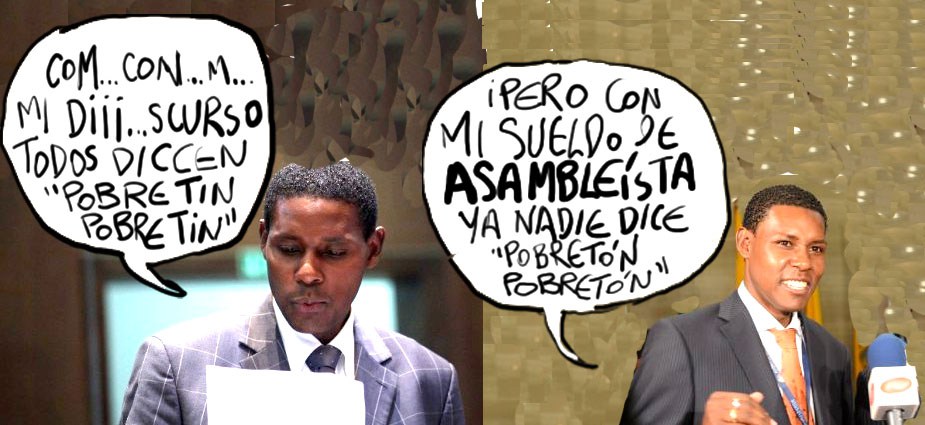
Bonil and El Universo ran afoul of the SuperCom censors again this year after Bonil published a cartoon photo montage depicting Agustín “Tín” Delgado, a former member of Ecuador’s national soccer team who was elected to the national assembly as part of Correa’s PAIS Alliance. The cartoon shows Delgado, who stutters, stumbling over his words during a speech. It also includes a play on words using “Pobre Tín,” or “poor Tín,” and “Pobretón,” or “poor guy,” to imply “that people may feel sorry for Delgado for fumbling a political speech, but no one feels sorry for his hefty government salary,” according to a translation by the Index on Censorship.

Correa responded by publicly labeling the cartoon racist since Delgado is of African ancestry. SuperCom has opened a case against Bonil over the cartoon, charging him with “economic and social discrimination” and has asked El Universo to publish an apology on its website’s home page for seven days.

Bonilla recently spoke with Global Journalist’s Jinghong Chen and Pablo Gabilondo about the charge and the media environment in Ecuador.

Global Journalist: What’s your experience with Ecuador’s Superintendent of Information and Communication (SuperCom)?

Bonilla: Last year, the Superintendent of Information and Communication made me run a correction to a cartoon. I think that is the first time and a unique case in the world, I guess. But the government also fined the newspaper $90,000.

Now one year later, the SuperCom called me again to explain a cartoon. Some groups of African descent said my cartoon is racist and socially and economically discriminatory.

I do not understand where there is discrimination. I asked them to prove where in the cartoon I am talking about skin color. I am talking about a member of the parliament for the ruling party who is in the national legislature but has difficulty reading. I asked people how can a representative who has problems reading make decisions for us, for my country and my family.

Who is the racist here? The president accused me of racism, which is a crime. But accusing someone of having committed a crime without evidence is also a crime.

GJ: How did the government respond to your arguments?

Bonilla: Their lawyer has talked about the history of racism, and he showed me many examples of racism around the world.

You can feel that you are offended by a cartoon, but accusing someone of discrimination is another thing.

You have to prove how that cartoon limits your rights, and I do not know how my cartoon has deprived the rights from this person. A journalist or anyone on the street has the right to watch and control the work of public officials. It’s a public function; it is our right. We can say whatever we think about them, because we pay them their wages.

GJ: What do you think of Ecuador’s communication law approved in 2013?

Bonilla: From the beginning of his government, President Correa has declared a war on journalists and the press. He said that the media are his enemies. His press secretary also said the press is like weeds that need to be cut down. The law is full of ambiguity, so the authorities operate freely, without any control.

For example, opinions are regulated by this law and this is one of the hidden issues. Opinions mustn’t be regulated. This violation would already make the law unconstitutional because the constitution guarantees freedom of expression and opinion for all citizens. Opinions are regulated because they’re considered as communication products.

GJ: You were fined $90,000 most recently. Previously you were forced to give back 2 percent of your wages for several months. How has this affected you?

Bonilla: For the moment I’ve been supported by the newspaper that published my cartoons. I’m just a guest, a citizen. I don’t get a wage for my job; I’m just a normal editorialist, but there’s no doubt that the fines affect the media. If a newspaper publishes my cartoons, it’ll be fined and the fine may increase.

[Part of the most recent sanction] would require printing apologies for seven days, which would leave the door open to future stupid sanctions related to racism in pictures or controversial headlines. What they did is totally subjective and illegal.

GJ: Does this law affect your day-to-day work as a cartoonist?

Bonilla: Not me personally, but I think it affects the newspaper. They have a lawyer who is constantly checking with the journalists and the editors to make sure that they don’t make mistakes. I think the editor is being censored, but not me, because I am a cartoonist. If I censor myself, I would not be a cartoonist anymore. A cartoonist cannot censor himself.

GJ: The government judges the cartoons as if they were journalistic articles, what do you think of this?

Bonilla: This can be very funny. For example, Correa is in a war against memes. The host of an important TV show [British comedian John Oliver of HBO’s “Last Week Tonight”] referred to this ridiculous issue in his show.

Correa replied to him by saying that jokes and comedians in general don’t exist in the United Kingdom, ignoring obviously a long list with names like Charles Chaplin and Rowan Atkinson.

Since the beginning, the government has tried to control all opinions that the president wouldn’t like. Many spots are created on TV in which Correa is idolized. It’s genuine propaganda. When he stated that my cartoon was racist, he literally called people to act against racist people. This is how the government works in Ecuador.

GJ: Do you think the climate for free expression will improve in the future?

Bonilla: It is very difficult because the communication law establishes an ombudsman. So there is a public officer paid by the private media whose job it is to censor or to decide whether content can be published or not. Mr. Correa also has proposed to modify the constitution to establish communication as a public service, like the water and electricity [allowing for greater government regulation]. The space is closing for cartoonists and for journalists.

This story is published on Global Journalist, a news website covering international news and free press issues with a radio and television program broadcast on NPR-affiliated station KBIA.

Mainland Traders Cause Friction in Hongkong

Hong Kong has long been known as a shopper’s paradise-particularly for people living in Shenzhen, a Chinese mainland city of 10.6 million just across a narrow river from the city. Beginning in 2009, immigration changes allowed Shenzhen residents to obtain multiple-entry visas to visit Hong Kong an unlimited number of times per year.

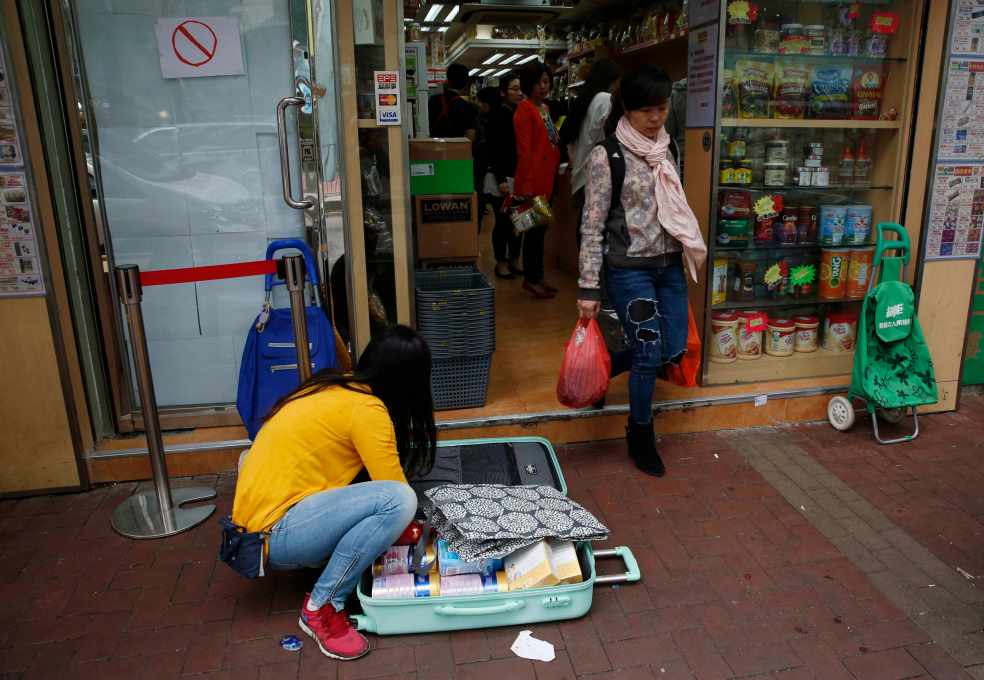
That helped fuel a surge in visits—with arrivals from mainland China reaching 47.3 million last year, up from 17.7 million when the new visas were introduced. Yet many of those visitors were so-called “parallel traders,” making day trips from the mainland to buy electronics, baby goods and pharmaceuticals in tax-free Hong Kong for resale on the mainland.

But since February, a series of anti-“parallel trading” protests have erupted in Hong Kong, leading to a drop in local tourism and new visa restrictions on people from Shenzhen.

The phenomenon follows the end of the “umbrella movement” democracy protests against mainland control, and is the latest evidence of tension in the one-country, two-systems model for Hong Kong. That tension was in evidence May 31 when as many as 3,000 people marched in Hong Kong to commemorate the 1989 Tiananmen Square crackdown, some bearing umbrellas.

Some in Hong Kong blame mainland Chinese for littering in shopping areas and complain of what they view as boorish behavior by mainland tourists. Mainlanders have been blamed for pushing up retail prices and causing shortages of some goods, and locals say stores catering to mainland shoppers have pushed up real estate prices and crowded out local businesses.

“We feel that we don’t have space to live,” says Ronald Leung, a spokesman for Hong Kong’s North District Parallel Imports Concern Group, a citizen’s organization, in an interview with Global Journalist. “Everyday when we go down the street, we see there are a lot of mainland people coming to our place, and we think that they are intruding.”

In one anti-trader incident in February in the Tuen Mun district, hundreds of protesters blocked shopping malls and chanted against parallel traders. Police used pepper spray and batons to break up the demonstrations and 13 people were arrested. In a separate protest March 1, 33 people were arrested.

But the demonstrators are fighting against the laws of supply and demand. In tax-free Hong Kong, the new Apple Watch sells for the equivalent of $553 while on the mainland it costs $675. Yet it’s not just high-value electronics and liquor that are bringing the traders, particularly since the 2009 loosening of visa restrictions on Shenzhen residents. China’s 2008 contaminated powder milk scandal, which sickened an estimated 40,000 babies, led to widespread loss of trust in Chinese food safety regulators and drove up demand for powder and other baby products like diapers from Hong Kong.

That left Hong Kong shoppers competing with parallel traders for a limited supply. “There has been an increase in numbers of pharmacies and shortages for baby formula at some stages,” Campbell Mok Ka Wai, a Hong Kong resident, told Global Journalist.

It also drove up rents as pharmacies catering to parallel traders took over shopping areas and rented Hong Kong apartments to use as distribution centers for their goods, says Wai.

Mainland and Hong Kong authorities have taken steps to address concerns. In 2012, more than 1,900 traders were arrested as part of a crackdown, most of them from the mainland. In 2013, Hong Kong imposed a four-pound limit on the amount of powdered milk allowed out of the county in an effort to ease shortages.

Following this year’s protests, the number of tourists to Hong Kong slumped. Mainland visits to Hong Kong in March declined 10 percent from the year previous, and 14 percent during the three-day Qingming Festival that ended April 6, according to Chinese state media. Those numbers aren’t likely to rise anytime soon. As of April 13, the multiple entry-visa for Shenzhen residents was eliminated, and replaced with a visa allowing one visit per week.

Leung, of the North District Parallel Imports Concern Group, says the change isn’t enough and likely won’t forestall future demonstrations. “It has been too long that our government does not do anything,” he says. That makes “Hong Kong people angrier and angrier.”

Yet stronger moves against traders also risk harming tourism to Hong Kong, a pillar of the city’s economy. Eric Chan Kwok-ki, director of Hong Kong’s immigration department, has warned that the anti-parallel trading protests have driven away tourists without reducing parallel trading.

“If the protests against parallel trading continues, tourism in Hong Kong will enter a cold winter, “ Yiu Si-Wing, a member of Hong Kong’s legislative council and deputy chairman of Hong Kong-based China Travel Service, told China Daily.

For Hong Kong residents fed up with the influx from the mainlanders crowding their streets and pushing up rents, that may be a trade-off worth taking. “They think Hong Kong is their supermarket,” says Leung.

This story is published on Global Journalist, a news website covering international news and free press issues with a radio and television program broadcast on NPR-affiliated station KBIA.

Project Exile: Dog Story Leads Sri Lanka Editor to Flee

Frederica Jansz surely knew that one day Sri Lanka’s government might force her out. After all, she became editor of the South Asian nation’s Sunday Leader newspaper only after her predecessor, Lasantha Wickrematunge, was shot through the head and killed in broad daylight in 2009. The killing came after the paper published a series of articles on corruption. In Wickrematunge’s final article, he wrote “…when finally I am killed, it will be the government that kills me.”

Soon after taking the top job at the newspaper, Jansz received a letter in red ink from someone threatening to “chop you up,” she told London’s Telegraph newspaper. It was similar to a letter Wickrematunge received just weeks before his death.

Jansz had joined the newspaper in 1994. While she worked there, its office was attacked nine times and set on fire twice. Jansz persevered, and made a name for herself as a reporter covering the Sri Lankan government’s 26-year civil war against the Tamil Tigers. Soon after becoming the newspaper’s editor in 2009, Jansz published an article reporting that the Sri Lankan military had shot and killed three senior Tiger leaders and their families as they were trying to surrender–apparently on orders from the government.

And yet it was not this article, but one about the defense minister and a dog that forced her from the country. Shortly after that article, detailed below, the Sunday Leader was purchased by an ally of the Sri Lankan government and Jansz was fired. But the threats against her continued.

“I felt that it would not stop,” says Jansz, in an interview with Global Journalist. “I think [there] was a good possibility that they would murder me as they had murdered Lasantha…I am a mom and I had two sons, so I just figured it was the time to leave.”

Now 48, Jansz lives in Washington state and is studying interior design. She spoke with Global Journalist’s Jinghong Chen about covering war crimes, filling the shoes of a boss who was murdered for his work and restarting life in a new country with a new profession.

GJ: What was it like to work as a journalist in Sri Lanka?

Jansz: It was challenging at all times. During my career as a journalist in Sri Lanka, I covered the civil war extensively. The war was finally concluded in 2009, without any credible witnesses [to the Tamil’s defeat], as the government forced out all media personnel from the war zone… As a result, conflicting reports allege that serious war crimes were committed.

And apart from that, it was all the government corruption. I think it finally came to a point that, it is not about the individual; it is just that the whole system is so corrupt.

I started to write for The Sunday Leader as far back as 1994. We were…very much the voice for the voiceless and the minorities. And the paper paid a huge price. Lasantha was murdered in 2009 as he drove to work. Then I took over, and the threats did not stop. Finally in 2012, I was sacked by the government by using a government stooge.

But they did not stop; they were going to file court cases against me despite the fact that I was no longer [an editor], and then I was followed by men on motorbikes. I figured it was time for me to stop playing a heroine, and be a mom, because I had two sons. So we left.

GJ: How could the government fire you? 

Jansz: Because of the kind of journalism that we were practicing, none of the state entities would advertise with the newspaper, which took off 60 percent of our revenue. So the paper was struggling for years.

The newspaper had approached a local businessman to help put the newspaper on the stock market, to make it go public in an endeavor to increase revenue while still maintaining its independence.

However, the government on hearing about the negotiations did a back door deal with the businessman where they ended up funding him to buy out the publisher and owner of The Sunday Leader and so, thereby ended private ownership and the independent stance of The Sunday Leader.

GJ: Is there a specific story that go you in trouble? 

Jansz: In 2012, I heard that Sri Lanka’s defense secretary, Gotabaya Rajapaksa, was trying to fly a puppy dog from Switzerland for his wife.

He had a pilot friend who flew for the Sri Lankan Airlines and wanted him to fly to Switzerland to bring down this puppy dog.

Yet this pilot was only qualified to fly the smaller bodied A330 but not the A340, which is the plane usually used to fly from Sri Lanka to Zurich in Switzerland. So just to accommodate [the pilot who was to get the dog], they switched the planes. Fifty-nine passengers were to be off loaded.

I called the defense secretary, and he just went berserk and he [verbally] abused me. Then I wrote a story and published the entire conversation. This caused a huge controversy. He was contacted by all the newspapers, including international news agencies. He did not want to forgive me for that public embarrassment and humiliation…[this] pushed them to give funds to this so-called investor to buy the newspaper and tell him to get rid of me.

GJ: How did you manage to flee Sri Lanka? 

Jansz: In 2009, the American ambassador called me because I had worked on a big story about the same man—the defense secretary—and I had received a lot of threats during that time. She…told me that they felt that my life would soon be in threat, and offered me a multiple entry visa to the U.S., for my two children and myself. I was frankly shocked and amazed, but I told her at that time that…I had no intention of leaving ever. But she asked me to keep it as a safety measure, so I did. Those visas were valid until 2015.

In 2012, when I was in trouble with them again, and when I was sacked and knew that I would go to jail, these visas were all I had. So I contacted the ambassador again, and told them that I was planning on using [the visas]. They helped me to get out. That was the only option we had at the time.

GJ: When you first arrived in America, how did you feel? 

Jansz: I felt lost. I was so traumatized and confused. We did not know what the future would be like. I had no family, no friends, nobody, and I was totally alone. It was a nightmare. And it took nearly two years for us to settle, to find work, to find school for my children….In fact, there were many times that I just wish that I could go home. And frankly, I still would like to go home. It just is that I had nothing to go back to any more. I have to make a life here in America.

GJ: Are you still working as a journalist? 

Jansz: I work as an interior designer in a company in Seattle.…I am certainly not a practicing and active journalist any more. I guess my career as a journalist is over.

Journalism is my passion and when I first came to America, I just felt totally drained and I figured that I would not do it again. But for me, [journalism] was never just a job. It was a passion for me. Even now, when I sit down to write, I cannot stop. I guess it is always there. It just is not a viable source of income for me any more in this country. So I went back to school to get another skill and follow another career path.

GJ: How do you perceive your future?

Jansz: I have to admit that right now my future seems so daunting. Here I am a single parent with two children. The future… in fact, is frightening. Because I keep thinking that it took me 20 years to reach the top in journalism in Sri Lanka, and I do not have another 20 years to reach the top as an interior designer in this country. So I need to get there faster, and I can only hope that America, being the land of opportunity, I will get there faster. The children have a great future. They are young enough and they have the time. But as for me, it is frightening.


Dr. Larry Dale Clark dedicated his life to theater, education

COLUMBIA — Even after he retired from his job as an MU theater professor and dean of the university’s College of Arts and Science, Dr. Larry Dale Clark remained committed to his passion, returning to the theater every day to do research in his office and the library.

He opened his office to students and colleagues. He even made up quizzes about theater history for other faculty to take for fun.

Dr. Clark kept coming into his office and working until he was no longer physically able to do so.

“He made it seem like it was no big deal, and he still kept busy researching and discussing passionately on acting, theater history and directing with his colleagues and students,” said David A. Crespy, director of undergraduate studies for the MU Department of Theatre. “He was an upbeat and positive guy.”

Dr. Clark died Wednesday, Dec. 24, 2014, in Columbia. He was 82.

He joined the MU faculty in 1966 as an assistant professor of speech and dramatic art and was named dean of the College of Arts and Science in 1988. He also worked as associate provost chair of the MU Department of Communication and as chair of the Department of Theatre.

“He was an encyclopedia of information about early 20th-century American theater history,” Crespy said.

“His imprint was large. He was a major leader in both theater practice and in the scholarship of theater,” he said.

Dr. Clark taught acting, directing and the history of American theater at MU and co-wrote the acting textbook, “Acting is Believing.” He established the doctoral program in theater at MU. He also founded the university’s Summer Repertory Theatre in 1969 and directed 32 plays for it and the University Theatre.

“He was himself a perfect combination of a practicing theater artist, as well as a working theater scholar,” Crespy said. “He represents a generation of professors who created the discipline of theater on the collegiate level.”

Dr. Clark was one of the founding members of the Kennedy Center American College Theatre Festival and a founding member and president of the Association for Theatre in Higher Education.

He was also a past national chair and president of the American Theatre Association, and past president of the University and College Theatre Association. He was named a Fellow of the American Theatre by the Kennedy Center in 1985. He also received the Kennedy Center Gold Medallion for his dedication to theater education.

Besides his scholarly reputation, Dr. Clark was remembered as an inspiring, kind and “incredibly welcoming presence.” He made a positive impression on not only his students but also his co-workers.

Mark Fauser, a former student, said Dr. Clark guided him through his final year in college.

“He really taught me a lot of lessons there,” said Fauser, now a California-based actor and a writer.

“He is one of the reasons that … I applied for the jobs here and why I took the job here,” said Suzanne Burgoyne, a professor in the Theatre Department.

The year she joined the faculty, she said she signed up for Dr. Clark’s American theatre history class. “I wanted to have the opportunity to learn from him,” Burgoyne said. The class turned out to be inspiring, she said.

The Department of Theatre was always full of joy when Dr. Clark worked as  chair, his colleagues said. His leadership and inspiring personality glued the department together.

“He made everything around him positive,” said James M. Miller, a theater professor. He knew Dr. Clark and worked closely with him for years.

“He made you feel wonderful about yourself,” Miller said.

Getting Dr. Clark’s approval was one of the reasons he worked so hard, Miller said.

Crespy recalled a meeting with Dr. Clark before the fall 2014 semester.

“He barely stopped talking. He was very curious about my work with Edward Albee and the New York theater scene and wanted to know everything about everything.”

“He was a huge influence of all of us,” Crespy said.

Dr. Clark and Yvonne Clark, his wife of 60 years, adopted his nephew, Marcus Murray, when the boy was a senior in high school.

Dr. Clark is survived by his wife; his son; a daughter-in-law, Rhonda Murray; and three grandchildren, Jessica of Las Vegas, Joe of Chicago and Julia of New York City.

A memorial service will be held at 10 a.m. Jan. 7, 2015, at Memorial Funeral Home, 1217 Business Loop 70 W., in Columbia.

In lieu of flowers, memorial contributions can be made to First Christian Church, Capital Campaign, 101 N. Tenth St., Columbia MO 65201; or to the National Parkinson Foundation, Gift Processing Center, P.O. Box 5018, Hagerstown MD 21741-5018.

The story is published at Columbia Missourian, a local newspaper.