Columbia’s KwikDish serves up tool to discover and order local meals

Rolla native AJ Shrestha was determined to start his own business years before he worked as a banker in San Francisco.

Last month, he moved back to Missouri with his food startup KwikDish, an online service that allows users to order lunch for pickup from local restaurants and cooks.

“Our hope is to turn Broadway into a giant cafeteria with healthy, local, fresh food,” Shrestha said, referring to the downtown Columbia street populated with local eateries.

KwikDish offers users a list of meals to pre-order and pick up at restaurants. The menu is posted online at 4 p.m. every day, and users have until 10 a.m. the next day to order. At that point, KwikDish sends the restaurants a final list of customers with order details and pick-up times.

“People don’t hang out in a restaurant. Instead, they get food delivered back home,” Shrestha said. “For the restaurants, it is not a good long-term solution.”

He hopes the pick-up method brings local restaurants an opportunity to sell additional items, as well as to show a personal touch with customers.

The price of a lunch meal ranges between $6 and $9. Users buy meal credits in bulk, choosing from three plans that include different numbers of meals and range in price from $32 to $90, before tax.

“The value on the customer side is saving money and time,” Shrestha said. “(The) price is attractive, and you tell (restaurants) when you are coming, so you don’t have to wait in long lines.”

KwikDish generates revenue by charging a fee of 8 to 10 percent of each transaction. Shrestha said the startup will rely on volume, rather than high margins, to be profitable.

Ever the entrepreneur

“Business has always been in my blood,” Shrestha said. “Ever since I was little, I would have some kind of business that I was running.”

When Shrestha was 15 years old, he started his first business, a game room in Rolla where kids could play sports and video games.

In college, he founded his own web development company, Snowlion Web, and hired young programmers to build websites.

After graduating from Missouri University of Science and Technology with a bachelor’s of electrical and computer engineering and a master’s of electrical engineering, Shrestha embarked on a career in engineering.

“Even as an engineer, I have always seen myself as a guy who loves to build products,” Shrestha said. “I love to make sure the customers see a value for it.”

Driven by his entrepreneurial spirit, he decided to shift gears and learn the language of business. He earned another master’s, in quantitative finance, from Georgia Tech and went on to work for Regions Bank, Raymond James and Deutsche Bank.

“I said to myself that … I will (work in banking) for about five years and after that I am going to do my own thing,” he said.

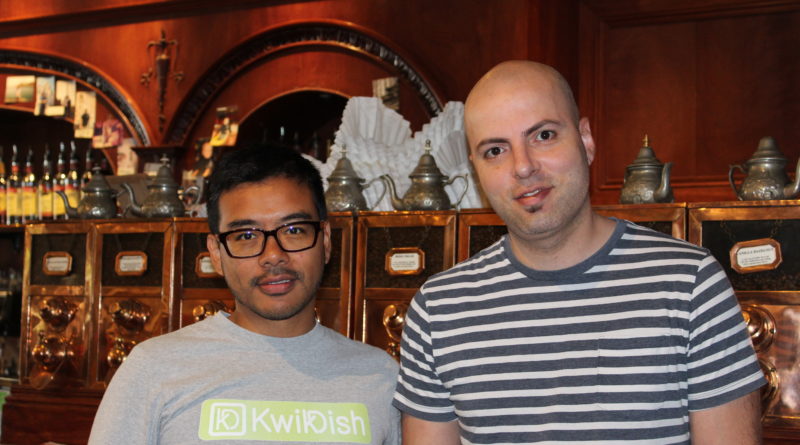
This year marks the fifth year since he made that pledge. Shrestha gave up his job at Deutsche Bank in February and jumped into entrepreneurship, launching KwikDish with three other co-founders: his wife, Alena Bloshakova, and two friends, Mahesh Dass and Carlos Solortano.

Before Shrestha left his job, he had already recruited a team of 15 people, predominantly engineers and bankers he has worked with. Two of them are full-time employees.

Leveraging local

In the competitive arena of food-delivery startups, even well-funded players like Zesty have struggled to stay in business.

Shrestha acknowledged the risk of jumping into such a competitive industry, but he added that “what really matters is the concept of local.”

Jennifer Goggin, a food-tech entrepreneur and strategic advisor for food-tech startups, said people want to support local farms and restaurants not only for the quality food, but also to keep money in the local economy.

“The question is, can you move them to actually act upon their desire to support the local restaurants?” Goggin said.

In Columbia, more than 30 local restaurants have agreed to put their menus on KwikDish. That group includes Sake Japanese Bistro, India’s House and The Grind Coffee House.

“It is hard in the beginning. (This is) a new face and a new idea from people who are not from the city,” Shrestha said. “But what we are trying to do is really concentrating on helping the local restaurants, and they do appreciate that.”

Issam Yanis of Coffee Zone, a coffee shop and Mediterranean restaurant in downtown Columbia, welcomed the idea because of its “local” emphasis. This is the first time Coffee Zone has joined a food platform.

“I like the idea,” Yannis said. “There are so many similar projects, but it seems this is the most attractive one I have heard of recently.”

He hopes to attract more traffic to Coffee Zone and gain visibility through KwikDish, because his shop is further from the University of Missouri campus than some other coffee shops.

Sonny Sindh, general manager of India’s House, and Indian restaurant in downtown Columbia, has similar expectations. He hopes KwikDish will give his restaurant “more public exposure.”

So far, about 100 customers have registered for KwikDish’s pick-up service. Shrestha said the startup will be more active with marketing as more MU students return to Columbia for the fall semester.

Eye toward expansion

While KwikDish has launched in Columbia and Jefferson City, Shrestha has his sights set on cities like St. Louis, Kansas City and Springfield. But launching in those cities will require more investment.

“The idea is that if you go to Jefferson City for the weekend, you can use the meal plan on KwikDish (to) find something that you know would be a good price point and … local,” said Dass, another of the KwikDish co-founders.

The startup plans to expand to Atlanta and Chicago by the end of the year, the team said. Dass said they have been in touch with angel investors and venture capitalists.

“For every customer we bring in, as long as they stay on or they increase the number of meals they have … that’s all suggesting they are appreciating our platform,” Shrestha said. “The numbers will tell the story.”

The story was published at Missouri Business Alert

North Korea Missile Tests Could Push Japan to Embrace Nuclear Weapons

On Tuesday morning, millions of people in northern Japan woke up to a government text alert warning that a ballistic missile test-fired from North Korea was passing overhead.

The missile was the first from Pyongyang to fly over Japan. Its flight lasted for two minutes before the projectile fell into the Pacific Ocean.

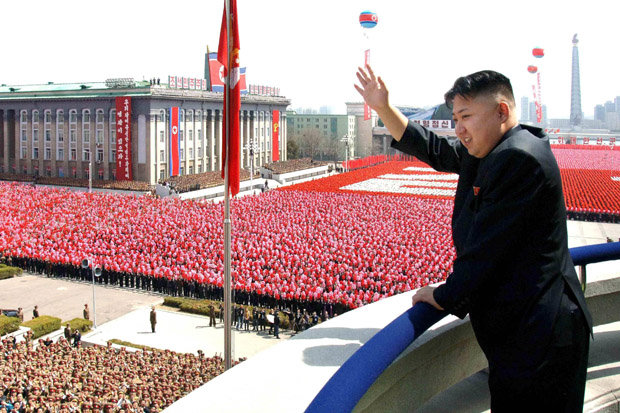
The launch of a North Korean missile towards Japan, a close ally of the United States, has further escalated tensions over leader Kim Jong-un‘s nuclear and ballistic weapons programs.

Japanese Prime Minister Shinzo Abe described the test as “reckless.” Following a 40-minute phone call with U.S. President Donald Trump on Tuesday, Mr. Abe said, “this launch of a North Korean missile is an unprecedented serious and grave threat to Japan.”

“For the first time since 1945, people in Tokyo, where I live, are feeling that we might be attacked by nuclear missile,” Ken Kato, director of Human Rights in Asia, told The Globe Post. “Japanese are mostly peace-loving, moderate and somewhat naïve people, but when the threat reaches a certain point, the whole society changes in a day. That happened a few times in our history.”

Given the short distance between Japan and North Korea, people don’t have much time to take cover in underground shelters or strong buildings in the event of an attack.

“It is obvious that if DPRK is seriously thinking about attacking Japan, Japan will not be able to defend [itself],” Dr. Tatsujiro Suzuki, director at the Research Center for Nuclear Weapons Abolition at Nagasaki University, told The Globe Post.

Dr. Suzuki added, “Many Japanese still trust American military strength (in particular ‘nuclear umbrella’) would deter DPRK to take military action.”

Pyongyang’s move also angered Mr. Trump, who warned on Tuesday that “all options are on the table” going forward.

In response to the missile test, the U.S. sent four advanced jet fighters and a pair of B-1B supersonic bombers over the Korean Peninsula in joint exercises with Japanese and South Korean air forces on Thursday.

The heightened military threat from North Korea also led to a new round of debate on whether Japan should acquire its own missiles, or even develop its own nuclear arms.

During the U.S. presidential election last year, Mr. Trump repeatedly suggested that Washington change its policy regarding Japan owning nuclear weapons. Washington has long maintained that the U.S. nuclear umbrella is adequate and prepared to defend Japan from an attack, provided Tokyo not develop its own nuclear weapons.

Mr. Kato said only conservatives in Japan are currently insisting Tokyo have nuclear weapons. “But if the threat from North Korea intensifies, I believe the majority of Japanese will support the idea. It is not difficult for Japan to develop nuclear weapons,” he said.

Tokyo has long taken a defensive military posture, and its armed forces are only for the sake of self-defense. Yet just two days after the missile test, Japan’s defense ministry is reportedly seeking a record $160 million in funding to add swift, longer-range missiles to its military arsenal.

Dr. Suzuki said public opinion in Japan may lean towards further nuclear reductions. “I don’t think DPRK threat will change Japanese public attitude towards nuclear power. In fact, because nuclear facilities could be potential targets of missile attack, some prefer to shut down existing plants as soon as possible or change the policy to restart the closed plant.”

It is clear that Japan is not Mr. Kim’s main target. Following Tuesday’s missile test, Mr. Kim made it clear that he plans “more ballistic rocket launching drills with the Pacific as a target,” according to North Korean state-run media reports.

The U.S. military demonstrated its ability to intercept a medium-range ballistic missile in the wake of North Korea’s launch. On Wednesday, the Navy and Missile Defense Agency tracked and shot down a test missile near Hawaii using a Standard Missile-6 interceptor missile.

“We will continue developing ballistic missile defense technologies to stay ahead of the threat as it evolves,” Missile Defense Agency Director Lt. Gen. Sam Greaves said.

The story was published at The Globe Post

US To North Korea: Time To Talk Is Over. What’s Next?

Threatening the U.S. with a total nuclear destruction is North Korea’s favorite pastime. But U.S. officials always shrugged off their bombastic rhetoric, downplaying their ability to hit U.S. territories.

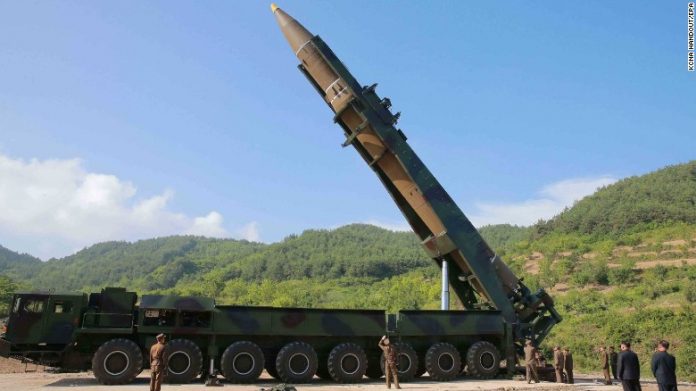
Nevertheless, recent successful tests of intercontinental ballistic missiles (ICBM), which theoretically could reach Alaska, has put Washington on edge. U.S. officials speculate that North Korea is a year away from developing a mini nuclear warhead that could fit on top of these missiles. Experts are still unsure if these missiles are tolerant to re-entry heating.

Last week, North Korea sparked a new round of fear and condemnation with the successful test of the ICBM. U.S. envoy to U.N. Nikki Haley tweeted that the “time for talk is over.”

Missile experts suggested the newly tested missile flew for a distance of 1,000 kilometers for 45 minutes. If fired on a standard trajectory, it could cover major U.S. cities including Los Angeles and Chicago.

“North Korea made a clear demonstration that it now has the capability of hitting the continental US,” Seong-Hyon Lee, senior research fellow at the Center for Korean Peninsula Studies at Peking University, told The Globe Post.

This missile test came just weeks after Pyongyang successfully tested its first ever ICBM. In 2017, North Korea has launched 11 ballistic missile tests.

In the wake of Pyongyang’s nuclear development, President Donald J. Trump vowed to take a tough stand against the regime.

On July 31, he told reporters at a Cabinet gathering that “we will handle North Korea. We’re going to be able to handle them. It will be handled. We handle everything.”

However, given the confusing remarks from the Trump administration, it seems the U.S. is still scrambling to figure out a policy on North Korea.

On Aug. 1, U.S. Secretary of State Rex W. Tillerson stressed that the U.S. is willing to talk with the regime of Kim Jong-Un. “We do not seek regime change. We do not seek an accelerated reunification of the peninsula. We do not seek an excuse to send our military north of the 38th parallel.”

Yet at the same day, U.S. Senator Lindsey Graham said on NBC that if North Korea continues its missile development, the U.S. will apply military operations to “destroy North Korea’s (missile) program and North Korea itself.”

Sangsoo Lee, senior research fellow at the Institute for Security & Development Policy, pointed out that the U.S. options are limited.

“Military measures are too risky and talks are too early since the US believes that North Korea’s nuclear warhead can’t reach the mainland US, as the country still doesn’t have ‘re-entry vehicle’,” he said.

North Korea’s longtime ally, China, seems not have many choices either.

A day after the missile test, Mr. Trump called on China and pressured it into making more action. He tweeted, “I am very disappointed in China. Our foolish past leaders have allowed them to make hundreds of billions of dollars a year in trade, yet they do NOTHING for us with North Korea, just talk. We will no longer allow this to continue. China could easily solve this problem!”

China has been North Korea’s biggest trade partner, representing 85 percent of total North Korean trade, according to a Washington D.C.-based research group C4ADS. In 2016, trade in anthracite coal made up over 46 percent of North Korean total export to China.

In February this year, Chinese Ministry of Commerce banned all coal imports from North Korea. In response to Mr. Trump’s criticism, China defended its efforts and hit back at Mr. Trump’s finger-pointing comment.

Chinese Vice Commerce Minister Qian Keming, replied at a news conference that nuclear issue and China-U.S. trade are “in two completely different domains” that should not be discussed together.

Chinese state media China Daily wrote in an editorial that Mr. Trump’s accusations are “unfair” and referred them as “simply a reflection of what has been his administration’s inaccurate assessment of the situation.”

Meanwhile, the editorial piece highly welcomed Mr. Tillerson’s “more rational perspective.” It is hoped the U.S. will now make concrete moves to translate Mr. Tillerson’s words into action, the editorial wrote, and the North will demonstrate its own sincerity to de-escalating tensions.”

While China was denouncing its small communist neighbor, Sangsoo Lee suggested that “it is unwilling to exert leverage on North Korea that could bring it to the brink of economic collapse and so trigger flows of refugees into China, as well as the US troops in the united Korea under South Korea’s domination.”

Moreover, if adding the South China Sea dispute and U.S. policy pivot in Asia, “China and the US cannot have cooperative relations and… China cannot simply alienate North Korea,” Sangsoo Lee said.

“Indeed, China could recover its relationship with North Korea to counter the US in the region.”

In The Economist’s cover story this week, the magazine said it is worth recalling that America has been here before.

“When Stalin and Mao were building their first atom bombs, some in the West urged pre-emptive strikes to stop them. Happily, cooler heads prevailed,” the Economist said.

Mr. Tillerson will head to Asia later this week for a regional meeting with ministers from North Korea, China, South Korea and Japan to discuss issues such as the denuclearization of the Korean Peninsula.

“The coming days and weeks will be a great disarray as experts and policy makers will be debating this confusing yet very important issue,” Seong-Hyon Lee said.

Before Mr. Tillerson’s visit, the U.S. proposed a draft resolution to be voted at the U.N. Security Council, aiming to cut North Korea’s $3 billion exports by a third.

The resolution will sanction any country purchasing North Korea’s exports of coal, iron, iron ore, lead, lead ore and seafood. Russia and China, as permanent members, must approve the resolution.

The story was published at The Globe Post

Qatar Embargo Came After Trump’s Blessing

Just a week after President Donald J. Trump’s first foreign trip, Persian Gulf is in an unprecedented regional crisis.

Last Monday, Saudi Arabia, the United Arab Emirates, Bahrain and Egypt first announced to break diplomatic ties with Qatar, accusing the tiny Gulf state of supporting terrorist groups such as Muslim Brotherhood. They closed land, air and sea links to Qatar and some have ordered to expel its citizens from their countries.

Qatar and several Gulf nations have been at odds for years, while this rift does follow Mr. Trump’s visit. President Trump himself appears to also take credit for it.

One day after Saudi Arabia’s move, Mr. Trump tweeted, “During my recent trip to the Middle East I stated that there can no longer be funding of Radical Ideology. Leaders pointed to Qatar – look!.”

He then wrote in a series of tweets, “[s]o good to see the Saudi Arabia visit with the King and 50 countries already paying off.” He added, “They said they would take a hard line on funding extremism, and all reference was pointing to Qatar. Perhaps this will be the beginning of the end to the horror of terrorism!”

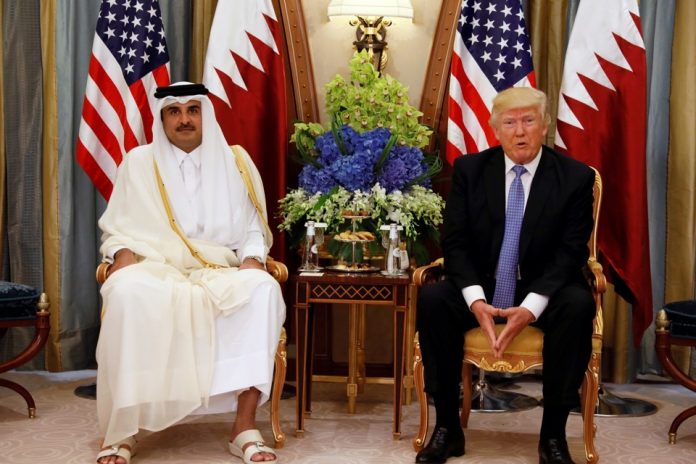
The tweets had bewildered Qatar’s ambassador to Washington and U.S. analysts. During Mr. Trump’s visit to Saudi Arabia, he had met with Qatari leader Emir Sheikh Tamim Bin Hamad Al-Thani and commented Qatar “a crucial strategic partner.” Qatar hosts the U.S. biggest military base in the Middle East to combat terrorism.

Despite Mr. Trump’s claim that he convinced the regional Arab allies to dump Qatar for its support for terrorism, his role is still unclear. It is not, however, surprising that Gulf countries would seek Mr. Trump’s blessing before tightening the noose around the closest U.S. ally in the Gulf.

As Ahmad Majidyar, director of IranObserved Project at Middle East Institute, told The Globe Post, “we cannot just judge by President’s tweets.”

Yet he also said that Mr. Trump’s visit might have played a part, as it sent a very strong signal to the Saudi government in fights against terrorism.

Gregory Gause, head of the International Affairs Department at Texas A&M University, shared a similar view. “I do think that the Emiratis and Saudis were emboldened by Trump’s visit to put pressure on Qatar. They certainly got the impression from the visit that Trump was going to be behind them,” Mr. Gause said to The Globe Post.

After the tweet rant, Mr. Trump is reversing his course. On Wednesday, in his phone call with Qatar leader, Mr. Trump emphasized the importance of uniting to defeat terrorism. He also “offered to help the parties resolve their differences, including through a meeting at the White House if necessary,” according to a White House statement.

He also spoke with Saudi King, Crown Prince of UAE and President of Egypt on the need for regional stability.

The Pentagon and the State Department had tried to ease the tensions. US Secretary of State Rex Tillerson called on Saudi, UAE, Bahrain, and Egypt to “ease the blockade against Qatar” last Friday.

Yet on the same day, Mr. Trump’s speech at the White House Rose Garden sent a different message.

“The nation of Qatar, unfortunately, has historically been a funder of terrorism at a very high level,” he said, asking Doha to “back among the unity of responsible nations.”

The U.S. normally plays as a mediator without picking sides when similar conflicts erupt in the Gulf region. However, as Mr. Gause said, “you have a president who is unpredictable on these things and a Secretary of Defense who is much more in the American diplomatic policy tradition… It was not like a coordinated plan where Trump is playing the bad cop and Secretary of Defense playing good cops.”

In a surprising move, the U.S. signed a $12 billion deal with Qatar to provide them at least 34 F-15 fighters jets.

To add more confusion to the unfolding saga, the U.S. ambassador to Qatar, Dana Shell Smith, announced her resignation on Twitter. It remains unclear whether her decision is related to the current crisis.

Iran and Turkey’s dilemma

Seen as a common threat in many Gulf nations, Iran is cast as a primary culprit in the breakdown of diplomatic relations as well as Mr. Trump’s motivation to tweet against Qatar.

Mr. Majidyar said that President Trump wishes the Gulf nations to unite against Iran. “As Qatar maintains a close relationship with Iran, that does go against with Washington politics.”

The crisis, however, has actually further pushed Qatar closer to Iran.

Iran has sent over 500 tons of food to Qatar with more coming every day, as the Gulf state is suffering the consequences of a closed land border with Saudi Arabia, where 40 percent of Qatar’s food comes from. Iran also opened its airspace for Qatari flights.

Mr. Majidyar pointed out that different voices have emerged in Iran’s government. While some suggested exploiting the crisis to weaken the American alliance and their impact, others had concerns over “unexpected damage” should Iran acts too aggressive.

In addition, Qatar and Saudi had differences in the past and they managed to resolve it. If it happens again, Iran’s investment would be on the line.

Amid the escalating crisis, Turkey also joined the group standing up for Qatar. President Recep Tayyip Erdogan approved to deploy military troops to Qatar and called for a total lifting of the blockade.

“There are those who are uncomfortable with us standing by our Qatari brothers, providing them with food. I’m sorry, we will continue to give Qatar every kind of support,” Mr. Erdogan said in a speech last Friday. “Until now I have not seen Qatar give support to terror.”

Turkey and Qatar cultivated a common strategy for years since the Arab Spring, when different factions of the Muslim Brotherhood thrived, according to Mr. Gause.

“The reason that the Turks are there is a subtle contest of influence within the Sunni community about what Islam means for politics among the Sunni community,” Mr. Gause said.

While Mr. Erdogan’s strong rhetoric appears to indicate Ankara’s stance, Turkey might also encounter a dilemma.

The desire to protect Qatari government to restrain the Gulf nations and the U.S. and to avoid damaging its relationship with Saudi Arabia makes it hard to remain a balance, Mr. Majidyar suggested.

The story was published on The Globe Post

China anti-gay stigma leads to marital deception

Li did not know that her marriage was based on a lie.

The 35-year-old officer worker from Qinghuangdao, in eastern China’s Hebei province, found out she was a “tongqi” six months after marriage. That term, which can be loosely translated into English as “gay-person’s wife,” is used to describe millions of Chinese straight women who unknowingly marry gay men.

China has around 20 million gay men, and about 80 percent of them marry a woman, according to an estimatefrom Zhang Beichuan, a prominent Chinese scholar who studies sexuality.  Being an openly gay man is socially unacceptable outside of large cities in China, and homosexuality is often still viewed as a medical condition even though the government no longer recognizes it as an illness.

And in a country where the one-child policy was the law of the land for decades, closeted gay men face enormous pressure to marry and start a family–even if they have no interest in women.

That leads many gay men to deceive women like Li, who asked that her full name not be used, into marrying them. The results of these marriages are often unhappy, and sometimes lead to physical and emotional abuse and the spread of sexually-transmitted diseases. In one widely reported incident, an instructor at Sichuan University jumped off a 13-floor building and died after discovering that her husband was gay.

Li’s marriage ended in divorce after she used a popular Chinese gay dating app known as “Blued” to learn the truth about her husband – and confronted him. “The more women know about my experience, the less chance they will end up with the same tragedy,” she says.

Li has sought help from other women who have had similar experiences through “tongqi” support groups. Still struggling with the aftermath of her China map-01divorce, Li, who posted about her experience on a ‘tongqi’ bulletin board on the Chinese site Baidu, shared her story with Global Journalist’s Weimeng Bao. Due to the sensitive nature of the topic, Global Journalist could not independently verify all aspects of her story.

Global Journalist: How did you meet your ex-husband? Did you notice anything unusual?

Li: We were introduced via an acquaintance at the end of 2015. My ex-husband was then 38 and had a six-month marriage in 2008. According to him, the previous divorce was because a health condition of his ex-wife’s made it hard for them to have sex.

We then started a relationship. We dated almost everyday, but he never took the initiative to contact me. After a few months, our parents got involved. Each were happy with the other family. My ex-husband soon proposed to me, and I said yes. We got married at the end of May.

We never had sex before marriage. Even a kiss was rare. But I thought this showed that he is a conservative, well-mannered guy. I did not think too much about it.


GJ: When did you start to suspect your husband was gay?

Li: After marriage, we rarely had sex. At the end of June, I accidentally overheard a phone call. My ex-husband was driving at the time and I was sitting by him. He put the call on speaker and a man asked him whether he was busy.

My ex-husband suddenly became furious, and started shouting into the phone: “I’m busy, I’m busy!”

He didn’t give the other man a chance to talk. The other man replied sadly, “OK.” Then my ex-husband immediately hung up the call.

I started to be suspicious after that incident. On the advice of a gay friend, I installed Blued on my phone. The app shows basic personal information of gay men around you, including their exact location [via GPS], age, height, weight and sexual orientation.

When my ex-husband was with me, I failed to find anybody like him on Blued. However soon after he left home, the app showed that there was a gay man 10 centimeters from me a half an hour ago. That is how I confirmed that my ex-husband is truly gay.

GJ: Did you talk to your ex-husband after discovering this?

Li: I talked to him almost right away. I showed him the Blued page, but he just explained that other gay men registered for him and he merely used the app to make friends. Nothing happened. He convinced me that he loved me and he only needed time to overcome his disgust for the female body. I believed him.

I tried several means in an attempt to convert him. I even tried my best to bear his child. He was still indifferent, refusing conversations with me. He hated me. Once I was mopping the floor while he was playing computer games. I hugged his right leg to act cute, but he hit me with his left slipper in response.

GJ: When did you decide to divorce him?

Li: One month after our talk, I decided to end the marriage. There was one night that my ex-husband decided he would sleep on the couch instead of sharing the bed with me. I was angry, and I said we have to divorce.

His face was distorted. He began to madly hit my head against the couch, punching my face over and over again. My glasses were sent flying and my right eye hurt so much that I could barely see anything. I was later diagnosed with posterior vitreous detachment [a condition caused by the retina separating from a membrane in the eye]. Even now, my right eye still has complications.

That is the night that I became determined to divorce him.

I then told his father that he is gay. His father did not seem surprised, and asked about my plan. I told him I wanted a divorce.

A few days later his mother, who was undergoing chemotherapy, came to me and begged me not to divorce her son. She said she would take my ex-husband to see doctors and cure the “disease.” She went to a fortune-teller for help, who told her that the “disease” could only be cured when he turns 42-years-old. His mother decided she didn’t want to hold me back, and approved the divorce.

As for my parents, they did not believe my ex-husband was gay. But they agreed to the divorce due to his abuse. I completed all the divorce paperwork within one month.

GJ: Did you feel better after the divorce?

Li: Not really. The pain tormented me for nearly three months.

Before finalizing the divorce proceedings, I was conflicted—I felt I could not live without him, but at the same time I was afraid of him refusing to divorce me.

Nearly no one knows that I have divorced. I didn’t want friends or colleagues around me to know about my divorce, let alone that my ex-husband is gay. For a time, I even changed the WeChat [a popular Chinese messaging app] name of a friend who often contacted me to “Husband.”

Two months after the divorce, a friend of mine who knew the real reason for my divorce pursued me. He is kind and warm, but I can’t bear any kind of intimacy – even hugs. Once, I could not help but kick him when he tried to kiss me.

When I was collecting evidence to verify that my husband is gay, I joined many QQ [a popular online chatting app] groups he was in. I saw too many hardcore pornographic images. Now I feel disgusted with men’s bodies.

GJ: Did all the ‘tongqi’ you know choose to get a divorce like you?

Li: Not every gay man’s wife will divorce. It mainly depends on personality and financial situation. Almost everyone struggled and suffered after they realized the truth. For some, their gay husbands may deceive them and tell them they are bisexual and like women as well as men, so the wives may hesitate to get a divorce. Their suffering could be short or long, even endless.

The financial condition matters, especially for those with children. I know an unemployed ‘tongqi’ with twins. She could just barely take care of one on her own, but could not endure having to separate them. So she stays in the marriage. But she always sends messages to the ‘tongqi’ QQ chat group at midnight, saying she woke up crying again.

GJ: Why do you think your husband married you in the first place? 

Li: I think he did this because he wants a child. Before we got divorced, I created a fake account to chat with him on a gay QQ group. He told me that a gay man must marry a straight woman as soon as he can, because otherwise siblings are the only people he can count on when he gets old. And if a gay man does not get married and has no child, he will disappoint his parents.

I asked him why doesn’t he marry a lesbian so he can also have children. He said this is weird and unacceptable.

GJ: Do you still take part in online support groups for women with gay husbands?

Li: Yes, I still chat in these groups every day. I used to just complain to the other ‘tongqi,’ but now I try to persuade them to get divorced as soon as possible. They are really vulnerable. For instance, one of the wives told me that she felt consoled after her husband showed her flirtatious messages he exchanged with other women in an effort to prove that he’s straight. It may sound weird, but these were her real thoughts.

with translation assistance from Xiaosheng Yin


The story was published at The Global Journalist

Art of balance

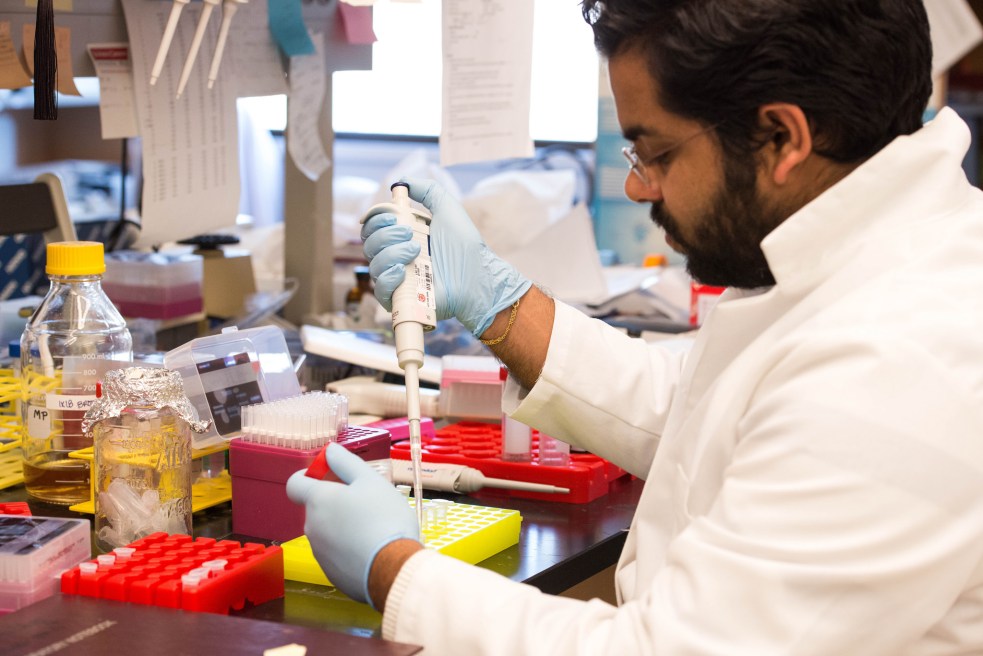
It might be strange to say, but in a way the Australian soil led scientist Michael Petris to where he is now.

In certain areas of Australia, soils suffer from extremely low level of copper bioavailability, resulting in poor growth and neurological problems on sheep.

Petris, a Bond LSC investigator and professor of biochemistry who was born in Australia, now spends his time studying how copper, an essential mineral in human body, works in cells to build and maintain essential functions.

Recently published work from his lab focuses on how the ATP7A protein, one of the major proteins, cycles within the cell.

“Copper is solely acquired from diet. The absorption of copper from the intestine in the blood needs ATP7A,” Vinit Shanbhag, a Ph.D. biochemistry student at Petris’ lab and an author of the study, said. “It transports copper to different copper dependent enzymes and exports free copper from the cell to the outside.”

After exporting copper at the cell membrane, ATP7A needs to come back to its steady-state location within the Golgi apparatus of cells – via a process called retrograde trafficking. But one question baffled scientists: what are the key elements that lead ATP7A coming back?

Back in the late 90s, Petris discovered the importance of one single di-leucine in retrograde trafficking of ATP7A. For those of you wondering, leucine is an amino acid that forms the building blocks of proteins like ATP7A, while di-leucine consists of two of them connected via a peptide bond.

His team wished to identify other signals for retrograde trafficking, but one technical hurdle stood in the way— the ATP7A gene is unstable when grown in bacterial plasmids, the traditional way of amplifying genes in the lab.

Commercial DNA synthesis was the answer. This method could create artificial genes in the laboratory.

“We reasoned that if we introduced enough silent mutations into a DNA sequence, we could avoid or change the region of instability in the native sequence without affecting the encoded protein,” Petris said.

To stabilize the gene, they changed more than 1,000 nucleotides within a 3,000 nucleotides segment, and thus solving the problem of instability of the ATP7A gene. In doing so, they subsequently found that in fact multiple di-leucines that are required for retrograde trafficking of ATP7A. This approach could be used by other laboratories whose gene of interest is also unstable.

An overlooked mineral 

“If you ask [people], is it important to understand iron nutrition? Is it important to understand calcium nutrition? Most people would say of course! … But, perhaps you would not get the same answer for copper, despite the fact there is a little dispute that copper is important,” Petris said.

As an essential micronutrient, copper performs central functions to develop and maintain human skin, bones, brains and other organs.

“If you don’t have enough copper in your body, you cannot use oxygen to make energy,” Petris said. “If you don’t have copper, you would not survive.”

Pregnant women who carry a mutated ATP7A gene on their X chromosome can pass it on to their children in the form of Menkes disease.

Menkes disease is a genetic disorder that results in poor uptake and distribution of copper to cells. The incidence of this disease is estimated to be one in 100,000 newborns, according to U.S. National Library of Medicine.

Infants with Menkes disease typically begin to develop symptoms during infancy and rarely live past the first few years of life. Abnormally high accumulation of copper in kidneys and low-level accumulation in the liver and brain, cause visible symptoms like sparse hair, loose skin and failure to grow.

Despite copper’s importance, it also can be a potentially toxic nutrient.

“Copper deficiency can be a problem but too much copper is also a problem. There should be a balance,” Shanbhag explained.

The liver normally stores excessive copper and excretes it into bile to release it out of the body. Yet people with genetic disorders that preventing copper excretion might suffer Wilson’s disease, leading to life-threatening organ damage.

Shanbhag said people with Wilson’s disease accumulate toxic amounts of copper in liver and other organs, causing Kayser–Fleischer rings that encircle the pigmented regions of the eye, a hue caused by copper deposits in the cornea.

Its clinical consequences differ from chornic liver failure to neurological sysmptoms like tremors, dystonia, ataxia and cognitive deteriortation.

About one in 30,000 people have Wilson disease, according to National Institute of Diabetes and Digestive and Kidney Diseases.

Starving tumors

In 2013, Petris’ lab published the first direct evidence suggesting ATP7A is essential for the dietary absorption of copper. Since then they have dug deeper into this copper transporter, and his lab now sets their sights on a greater enemy of human health — cancer.

Tumor growth requires access to large amounts of nutrients. Without an adequate supply of oxygen and nutrients, tumors fail to grow and survive. Scientists have identified that by preventing access to nutrients—for example by blocking the growth of new blood vessels—they could starve the tumor of nutrients.

Copper is a key nutrient for tumor growth. With the new-introduced system CRISPR-Cas9 — a genome editing tool to knock out specfic genes — his lab has explored how to exploit understanding of copper metabolic pathways to withhold copper from cancer cells.

“Copper starvation might be a good approach as an anti-cancer strategy,” Petris said.

Weapon of the immune system

Currently, four members study in Petris’ lab to tackle the relationship between copper and various diseases. Petris plans to expand his research to another area: the role of copper in innate immunity against bacterial pathogens.

This is the topic of Petris’ next grant. Nutritional immunity, which describes how the mammalian host withholds nutrients from the invading bacteria during infection, is very well-described for iron and zinc.

Yet copper performs differently.

During infection, the level of copper in blood actually goes up instead of going down. The immune system concentrates copper at sites of infection and within regions where the bacteria are engulfed.

“We speculate that copper is being used as weapon by the host to kill the bacteria,” Petris said. “That is the area we are trying to develop further.”

Michael Petris is a Bond LSC investigator and a professor of biochemistry. The study “Multiple di-leucines in the ATP7A copper transporter are required for retrograde trafficking to the trans-Golgi network” was published by The Royal Society of Chemistry in September 2016.


The story was published on Decoding Science

Ecuador Cartoonist Hit by Correa’s Crackdown

If there’s a face of Ecuador’s widening efforts to censor the press, it’s cartoonist Xavier Bonilla. Known by his pen name Bonil, his biting criticism of President Rafael Correa’s government has led to two high-profile run-ins with Ecuador’s new censorship office, the Superintendent of Information and Communication, or SuperCom.

Created by a 2013 communications law that granted the office wide latitude to prosecute and fine journalists and media outlets, SuperCom first went after Bonil for a cartoon published in December 2013 in the newspaper El Universo. The drawing depicted a police raid on the home of Fernando Villavicencio, a journalist and opposition politician who had been investigating the government’s handling of a lawsuit against oil company Chevron. It showed the police making off with not only files but a television and other electronic devices.

For this drawing, SuperCom fined El Universo 2 percent of its quarterly revenues and ordered Bonil to print a ‘correction’ to the cartoon. Bonil complied in February 2014 by publishing a cartoon portraying Villavicencio welcoming and encouraging security officials to empty his house. SuperCom did not respond to interview requests by Global Journalist.

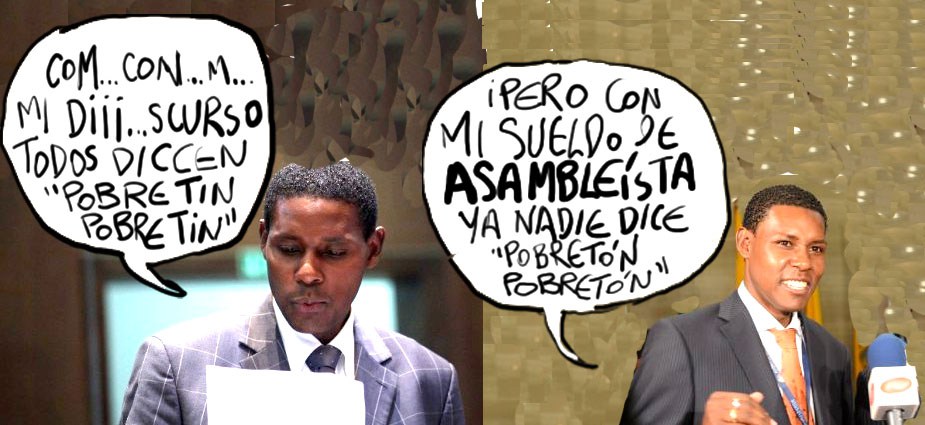
Bonil and El Universo ran afoul of the SuperCom censors again this year after Bonil published a cartoon photo montage depicting Agustín “Tín” Delgado, a former member of Ecuador’s national soccer team who was elected to the national assembly as part of Correa’s PAIS Alliance. The cartoon shows Delgado, who stutters, stumbling over his words during a speech. It also includes a play on words using “Pobre Tín,” or “poor Tín,” and “Pobretón,” or “poor guy,” to imply “that people may feel sorry for Delgado for fumbling a political speech, but no one feels sorry for his hefty government salary,” according to a translation by the Index on Censorship.

Correa responded by publicly labeling the cartoon racist since Delgado is of African ancestry. SuperCom has opened a case against Bonil over the cartoon, charging him with “economic and social discrimination” and has asked El Universo to publish an apology on its website’s home page for seven days.

Bonilla recently spoke with Global Journalist’s Jinghong Chen and Pablo Gabilondo about the charge and the media environment in Ecuador.

Global Journalist: What’s your experience with Ecuador’s Superintendent of Information and Communication (SuperCom)?

Bonilla: Last year, the Superintendent of Information and Communication made me run a correction to a cartoon. I think that is the first time and a unique case in the world, I guess. But the government also fined the newspaper $90,000.

Now one year later, the SuperCom called me again to explain a cartoon. Some groups of African descent said my cartoon is racist and socially and economically discriminatory.

I do not understand where there is discrimination. I asked them to prove where in the cartoon I am talking about skin color. I am talking about a member of the parliament for the ruling party who is in the national legislature but has difficulty reading. I asked people how can a representative who has problems reading make decisions for us, for my country and my family.

Who is the racist here? The president accused me of racism, which is a crime. But accusing someone of having committed a crime without evidence is also a crime.

GJ: How did the government respond to your arguments?

Bonilla: Their lawyer has talked about the history of racism, and he showed me many examples of racism around the world.

You can feel that you are offended by a cartoon, but accusing someone of discrimination is another thing.

You have to prove how that cartoon limits your rights, and I do not know how my cartoon has deprived the rights from this person. A journalist or anyone on the street has the right to watch and control the work of public officials. It’s a public function; it is our right. We can say whatever we think about them, because we pay them their wages.

GJ: What do you think of Ecuador’s communication law approved in 2013?

Bonilla: From the beginning of his government, President Correa has declared a war on journalists and the press. He said that the media are his enemies. His press secretary also said the press is like weeds that need to be cut down. The law is full of ambiguity, so the authorities operate freely, without any control.

For example, opinions are regulated by this law and this is one of the hidden issues. Opinions mustn’t be regulated. This violation would already make the law unconstitutional because the constitution guarantees freedom of expression and opinion for all citizens. Opinions are regulated because they’re considered as communication products.

GJ: You were fined $90,000 most recently. Previously you were forced to give back 2 percent of your wages for several months. How has this affected you?

Bonilla: For the moment I’ve been supported by the newspaper that published my cartoons. I’m just a guest, a citizen. I don’t get a wage for my job; I’m just a normal editorialist, but there’s no doubt that the fines affect the media. If a newspaper publishes my cartoons, it’ll be fined and the fine may increase.

[Part of the most recent sanction] would require printing apologies for seven days, which would leave the door open to future stupid sanctions related to racism in pictures or controversial headlines. What they did is totally subjective and illegal.

GJ: Does this law affect your day-to-day work as a cartoonist?

Bonilla: Not me personally, but I think it affects the newspaper. They have a lawyer who is constantly checking with the journalists and the editors to make sure that they don’t make mistakes. I think the editor is being censored, but not me, because I am a cartoonist. If I censor myself, I would not be a cartoonist anymore. A cartoonist cannot censor himself.

GJ: The government judges the cartoons as if they were journalistic articles, what do you think of this?

Bonilla: This can be very funny. For example, Correa is in a war against memes. The host of an important TV show [British comedian John Oliver of HBO’s “Last Week Tonight”] referred to this ridiculous issue in his show.

Correa replied to him by saying that jokes and comedians in general don’t exist in the United Kingdom, ignoring obviously a long list with names like Charles Chaplin and Rowan Atkinson.

Since the beginning, the government has tried to control all opinions that the president wouldn’t like. Many spots are created on TV in which Correa is idolized. It’s genuine propaganda. When he stated that my cartoon was racist, he literally called people to act against racist people. This is how the government works in Ecuador.

GJ: Do you think the climate for free expression will improve in the future?

Bonilla: It is very difficult because the communication law establishes an ombudsman. So there is a public officer paid by the private media whose job it is to censor or to decide whether content can be published or not. Mr. Correa also has proposed to modify the constitution to establish communication as a public service, like the water and electricity [allowing for greater government regulation]. The space is closing for cartoonists and for journalists.

This story is published on Global Journalist, a news website covering international news and free press issues with a radio and television program broadcast on NPR-affiliated station KBIA.

Mainland Traders Cause Friction in Hongkong

Hong Kong has long been known as a shopper’s paradise-particularly for people living in Shenzhen, a Chinese mainland city of 10.6 million just across a narrow river from the city. Beginning in 2009, immigration changes allowed Shenzhen residents to obtain multiple-entry visas to visit Hong Kong an unlimited number of times per year.

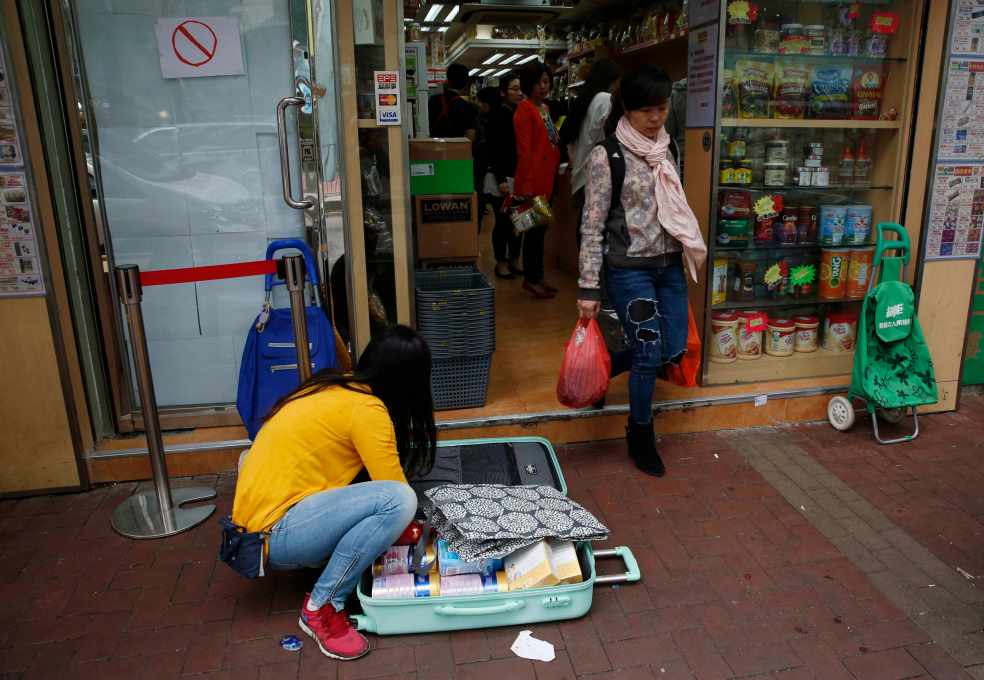
That helped fuel a surge in visits—with arrivals from mainland China reaching 47.3 million last year, up from 17.7 million when the new visas were introduced. Yet many of those visitors were so-called “parallel traders,” making day trips from the mainland to buy electronics, baby goods and pharmaceuticals in tax-free Hong Kong for resale on the mainland.

But since February, a series of anti-“parallel trading” protests have erupted in Hong Kong, leading to a drop in local tourism and new visa restrictions on people from Shenzhen.

The phenomenon follows the end of the “umbrella movement” democracy protests against mainland control, and is the latest evidence of tension in the one-country, two-systems model for Hong Kong. That tension was in evidence May 31 when as many as 3,000 people marched in Hong Kong to commemorate the 1989 Tiananmen Square crackdown, some bearing umbrellas.

Some in Hong Kong blame mainland Chinese for littering in shopping areas and complain of what they view as boorish behavior by mainland tourists. Mainlanders have been blamed for pushing up retail prices and causing shortages of some goods, and locals say stores catering to mainland shoppers have pushed up real estate prices and crowded out local businesses.

“We feel that we don’t have space to live,” says Ronald Leung, a spokesman for Hong Kong’s North District Parallel Imports Concern Group, a citizen’s organization, in an interview with Global Journalist. “Everyday when we go down the street, we see there are a lot of mainland people coming to our place, and we think that they are intruding.”

In one anti-trader incident in February in the Tuen Mun district, hundreds of protesters blocked shopping malls and chanted against parallel traders. Police used pepper spray and batons to break up the demonstrations and 13 people were arrested. In a separate protest March 1, 33 people were arrested.

But the demonstrators are fighting against the laws of supply and demand. In tax-free Hong Kong, the new Apple Watch sells for the equivalent of $553 while on the mainland it costs $675. Yet it’s not just high-value electronics and liquor that are bringing the traders, particularly since the 2009 loosening of visa restrictions on Shenzhen residents. China’s 2008 contaminated powder milk scandal, which sickened an estimated 40,000 babies, led to widespread loss of trust in Chinese food safety regulators and drove up demand for powder and other baby products like diapers from Hong Kong.

That left Hong Kong shoppers competing with parallel traders for a limited supply. “There has been an increase in numbers of pharmacies and shortages for baby formula at some stages,” Campbell Mok Ka Wai, a Hong Kong resident, told Global Journalist.

It also drove up rents as pharmacies catering to parallel traders took over shopping areas and rented Hong Kong apartments to use as distribution centers for their goods, says Wai.

Mainland and Hong Kong authorities have taken steps to address concerns. In 2012, more than 1,900 traders were arrested as part of a crackdown, most of them from the mainland. In 2013, Hong Kong imposed a four-pound limit on the amount of powdered milk allowed out of the county in an effort to ease shortages.

Following this year’s protests, the number of tourists to Hong Kong slumped. Mainland visits to Hong Kong in March declined 10 percent from the year previous, and 14 percent during the three-day Qingming Festival that ended April 6, according to Chinese state media. Those numbers aren’t likely to rise anytime soon. As of April 13, the multiple entry-visa for Shenzhen residents was eliminated, and replaced with a visa allowing one visit per week.

Leung, of the North District Parallel Imports Concern Group, says the change isn’t enough and likely won’t forestall future demonstrations. “It has been too long that our government does not do anything,” he says. That makes “Hong Kong people angrier and angrier.”

Yet stronger moves against traders also risk harming tourism to Hong Kong, a pillar of the city’s economy. Eric Chan Kwok-ki, director of Hong Kong’s immigration department, has warned that the anti-parallel trading protests have driven away tourists without reducing parallel trading.

“If the protests against parallel trading continues, tourism in Hong Kong will enter a cold winter, “ Yiu Si-Wing, a member of Hong Kong’s legislative council and deputy chairman of Hong Kong-based China Travel Service, told China Daily.

For Hong Kong residents fed up with the influx from the mainlanders crowding their streets and pushing up rents, that may be a trade-off worth taking. “They think Hong Kong is their supermarket,” says Leung.

This story is published on Global Journalist, a news website covering international news and free press issues with a radio and television program broadcast on NPR-affiliated station KBIA.

Project Exile: Dog Story Leads Sri Lanka Editor to Flee

Frederica Jansz surely knew that one day Sri Lanka’s government might force her out. After all, she became editor of the South Asian nation’s Sunday Leader newspaper only after her predecessor, Lasantha Wickrematunge, was shot through the head and killed in broad daylight in 2009. The killing came after the paper published a series of articles on corruption. In Wickrematunge’s final article, he wrote “…when finally I am killed, it will be the government that kills me.”

Soon after taking the top job at the newspaper, Jansz received a letter in red ink from someone threatening to “chop you up,” she told London’s Telegraph newspaper. It was similar to a letter Wickrematunge received just weeks before his death.

Jansz had joined the newspaper in 1994. While she worked there, its office was attacked nine times and set on fire twice. Jansz persevered, and made a name for herself as a reporter covering the Sri Lankan government’s 26-year civil war against the Tamil Tigers. Soon after becoming the newspaper’s editor in 2009, Jansz published an article reporting that the Sri Lankan military had shot and killed three senior Tiger leaders and their families as they were trying to surrender–apparently on orders from the government.

And yet it was not this article, but one about the defense minister and a dog that forced her from the country. Shortly after that article, detailed below, the Sunday Leader was purchased by an ally of the Sri Lankan government and Jansz was fired. But the threats against her continued.

“I felt that it would not stop,” says Jansz, in an interview with Global Journalist. “I think [there] was a good possibility that they would murder me as they had murdered Lasantha…I am a mom and I had two sons, so I just figured it was the time to leave.”

Now 48, Jansz lives in Washington state and is studying interior design. She spoke with Global Journalist’s Jinghong Chen about covering war crimes, filling the shoes of a boss who was murdered for his work and restarting life in a new country with a new profession.

GJ: What was it like to work as a journalist in Sri Lanka?

Jansz: It was challenging at all times. During my career as a journalist in Sri Lanka, I covered the civil war extensively. The war was finally concluded in 2009, without any credible witnesses [to the Tamil’s defeat], as the government forced out all media personnel from the war zone… As a result, conflicting reports allege that serious war crimes were committed.

And apart from that, it was all the government corruption. I think it finally came to a point that, it is not about the individual; it is just that the whole system is so corrupt.

I started to write for The Sunday Leader as far back as 1994. We were…very much the voice for the voiceless and the minorities. And the paper paid a huge price. Lasantha was murdered in 2009 as he drove to work. Then I took over, and the threats did not stop. Finally in 2012, I was sacked by the government by using a government stooge.

But they did not stop; they were going to file court cases against me despite the fact that I was no longer [an editor], and then I was followed by men on motorbikes. I figured it was time for me to stop playing a heroine, and be a mom, because I had two sons. So we left.

GJ: How could the government fire you? 

Jansz: Because of the kind of journalism that we were practicing, none of the state entities would advertise with the newspaper, which took off 60 percent of our revenue. So the paper was struggling for years.

The newspaper had approached a local businessman to help put the newspaper on the stock market, to make it go public in an endeavor to increase revenue while still maintaining its independence.

However, the government on hearing about the negotiations did a back door deal with the businessman where they ended up funding him to buy out the publisher and owner of The Sunday Leader and so, thereby ended private ownership and the independent stance of The Sunday Leader.

GJ: Is there a specific story that go you in trouble? 

Jansz: In 2012, I heard that Sri Lanka’s defense secretary, Gotabaya Rajapaksa, was trying to fly a puppy dog from Switzerland for his wife.

He had a pilot friend who flew for the Sri Lankan Airlines and wanted him to fly to Switzerland to bring down this puppy dog.

Yet this pilot was only qualified to fly the smaller bodied A330 but not the A340, which is the plane usually used to fly from Sri Lanka to Zurich in Switzerland. So just to accommodate [the pilot who was to get the dog], they switched the planes. Fifty-nine passengers were to be off loaded.

I called the defense secretary, and he just went berserk and he [verbally] abused me. Then I wrote a story and published the entire conversation. This caused a huge controversy. He was contacted by all the newspapers, including international news agencies. He did not want to forgive me for that public embarrassment and humiliation…[this] pushed them to give funds to this so-called investor to buy the newspaper and tell him to get rid of me.

GJ: How did you manage to flee Sri Lanka? 

Jansz: In 2009, the American ambassador called me because I had worked on a big story about the same man—the defense secretary—and I had received a lot of threats during that time. She…told me that they felt that my life would soon be in threat, and offered me a multiple entry visa to the U.S., for my two children and myself. I was frankly shocked and amazed, but I told her at that time that…I had no intention of leaving ever. But she asked me to keep it as a safety measure, so I did. Those visas were valid until 2015.

In 2012, when I was in trouble with them again, and when I was sacked and knew that I would go to jail, these visas were all I had. So I contacted the ambassador again, and told them that I was planning on using [the visas]. They helped me to get out. That was the only option we had at the time.

GJ: When you first arrived in America, how did you feel? 

Jansz: I felt lost. I was so traumatized and confused. We did not know what the future would be like. I had no family, no friends, nobody, and I was totally alone. It was a nightmare. And it took nearly two years for us to settle, to find work, to find school for my children….In fact, there were many times that I just wish that I could go home. And frankly, I still would like to go home. It just is that I had nothing to go back to any more. I have to make a life here in America.

GJ: Are you still working as a journalist? 

Jansz: I work as an interior designer in a company in Seattle.…I am certainly not a practicing and active journalist any more. I guess my career as a journalist is over.

Journalism is my passion and when I first came to America, I just felt totally drained and I figured that I would not do it again. But for me, [journalism] was never just a job. It was a passion for me. Even now, when I sit down to write, I cannot stop. I guess it is always there. It just is not a viable source of income for me any more in this country. So I went back to school to get another skill and follow another career path.

GJ: How do you perceive your future?

Jansz: I have to admit that right now my future seems so daunting. Here I am a single parent with two children. The future… in fact, is frightening. Because I keep thinking that it took me 20 years to reach the top in journalism in Sri Lanka, and I do not have another 20 years to reach the top as an interior designer in this country. So I need to get there faster, and I can only hope that America, being the land of opportunity, I will get there faster. The children have a great future. They are young enough and they have the time. But as for me, it is frightening.

Dr. Larry Dale Clark dedicated his life to theater, education

COLUMBIA — Even after he retired from his job as an MU theater professor and dean of the university’s College of Arts and Science, Dr. Larry Dale Clark remained committed to his passion, returning to the theater every day to do research in his office and the library.

He opened his office to students and colleagues. He even made up quizzes about theater history for other faculty to take for fun.

Dr. Clark kept coming into his office and working until he was no longer physically able to do so.

“He made it seem like it was no big deal, and he still kept busy researching and discussing passionately on acting, theater history and directing with his colleagues and students,” said David A. Crespy, director of undergraduate studies for the MU Department of Theatre. “He was an upbeat and positive guy.”

Dr. Clark died Wednesday, Dec. 24, 2014, in Columbia. He was 82.

He joined the MU faculty in 1966 as an assistant professor of speech and dramatic art and was named dean of the College of Arts and Science in 1988. He also worked as associate provost chair of the MU Department of Communication and as chair of the Department of Theatre.

“He was an encyclopedia of information about early 20th-century American theater history,” Crespy said.

“His imprint was large. He was a major leader in both theater practice and in the scholarship of theater,” he said.

Dr. Clark taught acting, directing and the history of American theater at MU and co-wrote the acting textbook, “Acting is Believing.” He established the doctoral program in theater at MU. He also founded the university’s Summer Repertory Theatre in 1969 and directed 32 plays for it and the University Theatre.

“He was himself a perfect combination of a practicing theater artist, as well as a working theater scholar,” Crespy said. “He represents a generation of professors who created the discipline of theater on the collegiate level.”

Dr. Clark was one of the founding members of the Kennedy Center American College Theatre Festival and a founding member and president of the Association for Theatre in Higher Education.

He was also a past national chair and president of the American Theatre Association, and past president of the University and College Theatre Association. He was named a Fellow of the American Theatre by the Kennedy Center in 1985. He also received the Kennedy Center Gold Medallion for his dedication to theater education.

Besides his scholarly reputation, Dr. Clark was remembered as an inspiring, kind and “incredibly welcoming presence.” He made a positive impression on not only his students but also his co-workers.

Mark Fauser, a former student, said Dr. Clark guided him through his final year in college.

“He really taught me a lot of lessons there,” said Fauser, now a California-based actor and a writer.

“He is one of the reasons that … I applied for the jobs here and why I took the job here,” said Suzanne Burgoyne, a professor in the Theatre Department.

The year she joined the faculty, she said she signed up for Dr. Clark’s American theatre history class. “I wanted to have the opportunity to learn from him,” Burgoyne said. The class turned out to be inspiring, she said.

The Department of Theatre was always full of joy when Dr. Clark worked as  chair, his colleagues said. His leadership and inspiring personality glued the department together.

“He made everything around him positive,” said James M. Miller, a theater professor. He knew Dr. Clark and worked closely with him for years.

“He made you feel wonderful about yourself,” Miller said.

Getting Dr. Clark’s approval was one of the reasons he worked so hard, Miller said.

Crespy recalled a meeting with Dr. Clark before the fall 2014 semester.

“He barely stopped talking. He was very curious about my work with Edward Albee and the New York theater scene and wanted to know everything about everything.”

“He was a huge influence of all of us,” Crespy said.

Dr. Clark and Yvonne Clark, his wife of 60 years, adopted his nephew, Marcus Murray, when the boy was a senior in high school.

Dr. Clark is survived by his wife; his son; a daughter-in-law, Rhonda Murray; and three grandchildren, Jessica of Las Vegas, Joe of Chicago and Julia of New York City.

A memorial service will be held at 10 a.m. Jan. 7, 2015, at Memorial Funeral Home, 1217 Business Loop 70 W., in Columbia.

In lieu of flowers, memorial contributions can be made to First Christian Church, Capital Campaign, 101 N. Tenth St., Columbia MO 65201; or to the National Parkinson Foundation, Gift Processing Center, P.O. Box 5018, Hagerstown MD 21741-5018.

The story is published at Columbia Missourian, a local newspaper.